Safety & Etiquette At Apache
By Tim Kelly
Here are the four fundamental rules you’ll follow every single time you pick up a firearm:
- Treat every firearm as if it were loaded.
- Never point a firearm at anything you do not wish to shoot, kill, or destroy.
- Keep your finger straight and off the trigger until you are ready to shoot.
- Keep the gun unloaded until ready to use.
Safety /ˈsāftē/ Noun
- The condition of being protected from or unlikely to cause danger, risk, or injury.
Etiquette /ˈedəkət/ Noun
- The customary code of polite behavior in society or among members of a particular profession or group.
These two words sound similar, but they are very different—and understanding the difference will make you a safer, more confident shooter right from the start.
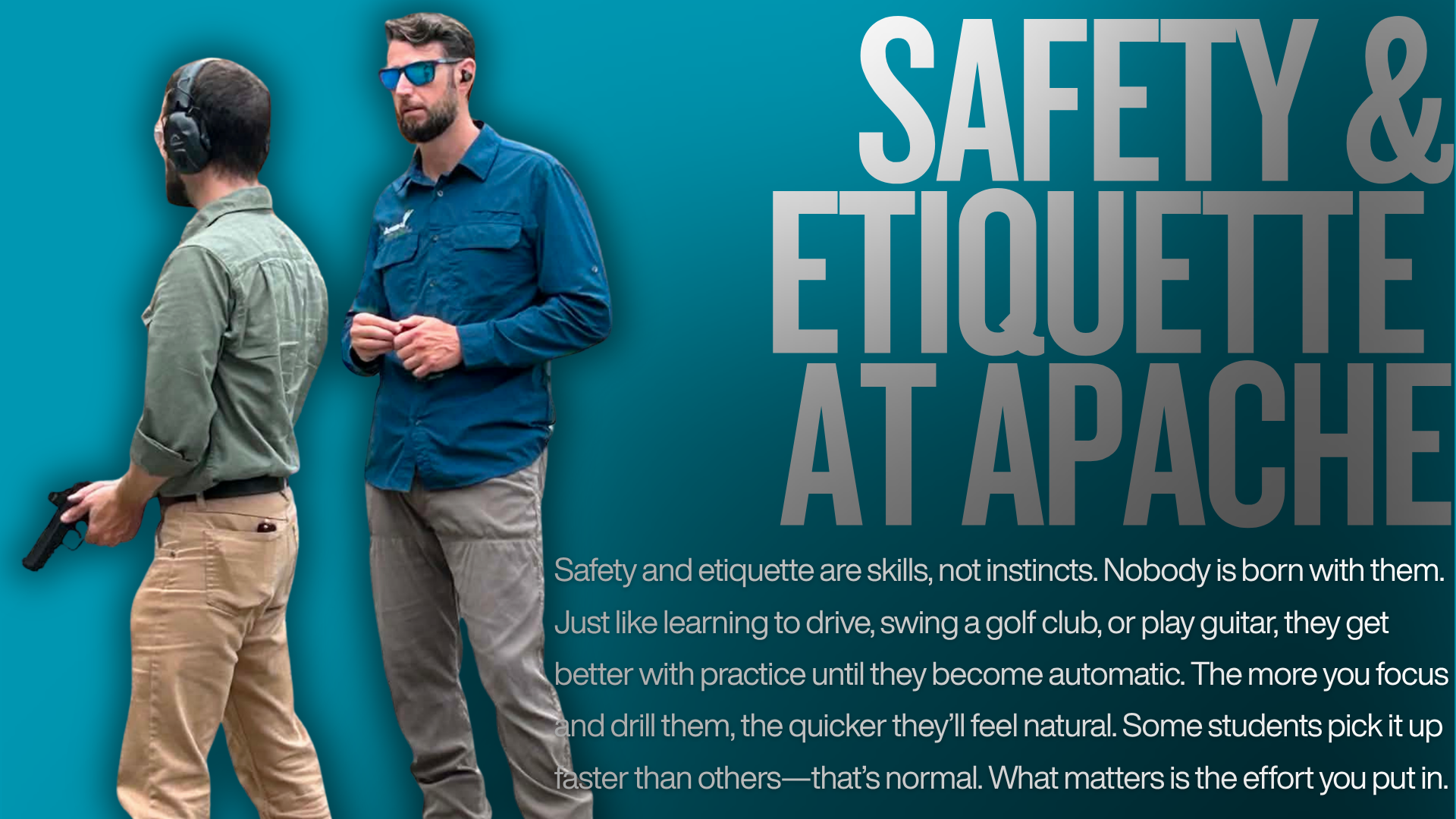
Safety and etiquette are skills, not instincts. Nobody is born with them. Just like learning to drive, swing a golf club, or play guitar, they get better with practice until they become automatic. The more you focus and drill them, the quicker they’ll feel natural. Some students pick it up faster than others—that’s normal. What matters is the effort you put in.
These four rules were chosen because they cover everything that I need to explain gun safety to a new shooter. Other lists exist, but these keep things simple and easy for me to explain. It is not meant to deduct from other important rules that others may use to explain gun safety. It also doesn’t mean that in a live-fire class, you will not hear other important factors of handling a firearm in various contexts (e.g., let falling objects fall, know your target and what is beyond it, don't bend over on the line, etc.). These rules are designed to evolve as your training progresses and adapt to different environments.
For now, let’s walk through each rule the way you’ll generally use them at our range—especially in a private lesson where you bring your own handgun.
Rule #4: Keep the gun unloaded until ready to use.
When you first arrive, your instructor assumes that you are carrying a loaded gun on your person or unloaded in a bag. Regardless of whether you are or not, your instructor will show you a safe direction to point the muzzle. You’ll unload your pistol or revolver, lock the slide back or open the cylinder, and set it on the table in the staging area. At that moment, the gun is not “ready to use,” so it stays unloaded. Only when you step up to the firing line, with a proper backstop and target in front of you, will you load the firearm. This keeps everything simple and safe.
Rule #3: Keep your finger straight and off the trigger until you are ready to shoot.
After identifying a sufficient backstop, pick up the handgun with your dominant hand while placing your trigger finger flat along the side of the slide or cylinder, pointing in the same direction as the barrel. This is called “registering” or “indexing” your finger. It’s your new habit and a very important one to develop. Your finger lives here until the sights are on target and you have decided to shoot.
Rule #2: Never point a firearm at anything you do not wish to shoot, kill, or destroy.
The gun is neither safe nor unsafe by itself. It is only when someone touches it that it develops the potential to become unsafe. Using your registered trigger finger and your peripheral vision as guides, always keep the muzzle pointed in a direction of least consequence. There’s a difference between “pointing” (doing it on purpose) and “flagging” (accidentally letting the muzzle sweep something you don’t want to point at). Both are on you to control. Before you ever pick the gun up, you must deliberately choose the safest direction to point it.
Rules #2 + #3 = Rule #1: Treat every firearm as if it were loaded.
If you can follow each of the above rules, in turn, you are treating every firearm as if it were loaded.
Here’s the practical position that makes everything work at once. The “shopping-cart carry”:
While holding the handgun in your dominant hand, bend your elbow slightly, rotate your wrist like you’re pushing a grocery cart, and point the muzzle down at the ground 2–3 feet in front of your feet. Your trigger finger stays registered along the side. This position uses your body’s natural awareness (proprioception) and a bit of your periphery, so you always know exactly where the muzzle is pointing, even while you’re walking from the table to the firing line.
Now picture yourself doing it: You identify an area that is acceptable to point your muzzle, pick up your cleared handgun, lock the slide back or leave the cylinder open, use the shopping-cart carry, and walk to the line. Even with other people nearby, you can move safely without flagging anyone so long as you are being intentional. The direction of travel (up-range or down-range) doesn’t change the safety as long as you keep these habits.
Safety vs. Etiquette – Why This Matters for You
You’ll see some range habits that look “scary” but aren’t actually unsafe–like someone refusing to walk in front of a gun lying on the table with the action open. If you ask why, they often just say “It’s unsafe,” but can’t explain how. That’s an etiquette issue, not a safety issue. Guns don’t load themselves or fire by magic. People who are careless or ignorant are the danger, not the tool.
Example:
- Finger on the trigger while the muzzle is pointed at a safe backstop with nothing in between? That’s bad etiquette. Worst case: the gun goes off into the dirt. No one gets hurt. It doesn’t mean that this shouldn’t be corrected—keep reading.
- Gun unloaded, cleared, and double-checked, but someone points it at or flags another person with their finger OFF the trigger? Nothing can happen. Absolutely nothing. It doesn’t mean that it isn’t wrong! It just means that this current situation is not “unsafe.” It doesn’t mean that you shouldn’t be offended or treat this with great caution; it just means that the current situation is not “unsafe.”
Calling these things “unsafe” creates unnecessary fear. Fear makes students put the gun away at home and never practice. Politeness, on the other hand, is something adults are happy to work on so they don’t look silly or offend anyone next time.
If your instructor sees you accidentally put your finger inside the trigger guard while picking up the gun (even though it’s pointed safely down-range), they’ll calmly say: “Pause for a second—keep your finger off the trigger until your grip is solid and you’re on target.” No yelling, no panic. Just a quick correction to keep you in control.
You are in control. The firearm is an inanimate object. It has no brain, no will, no magic. When you follow these four rules, you stay safe. When you slip into bad etiquette, you simply fix it and keep going—no fear required.
Some programs make students carry guns in bags or totes everywhere because they treat any handling as “unsafe.” While I don’t subscribe to this idea, I can see how it can be used as a blanket redundancy to keep large groups of people accountable. However, in a well-controlled lesson at Apache, you’ll be taught and permitted to move safely with the gun in your hand so you can build a more practical skill.
Here is what I mean by more practical. If your gun is at home, inside your gun safe, and you intend to take it to another room to clean it, will you pick this gun up, put it in a bag or tote, and then carry said container to the other room? Or will you just pick it up and carry it to another room? I would bet on the latter. If that is the case, our purpose in private sessions is to guide you in the right direction on and off the range. This is why we practice this method in a controlled environment, so that you can take that knowledge home and use it there.
You’ve got this. Practice the four rules and the shopping-cart position every time you handle a firearm. The more you do it, the more natural it becomes—and the more you’ll enjoy shooting without ever worrying about being “unsafe.”