Choosing a Handgun for Everyday Carry
Tim Kelly
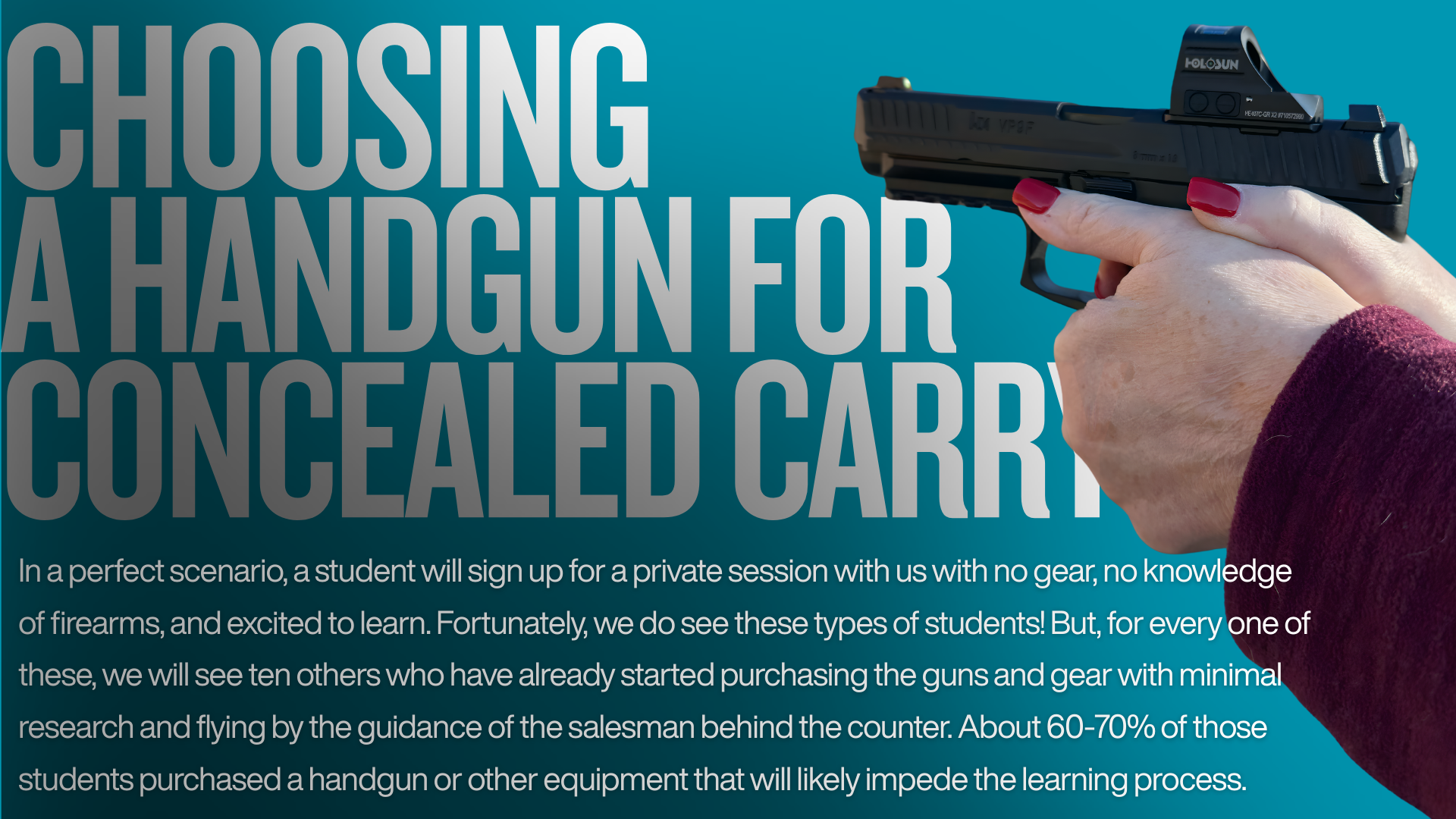
In a perfect scenario, a student will sign up for a private session with us with no gear, no knowledge of firearms, and excited to learn. Fortunately, we do see these types of students! But, for every one of these, we will see ten others who have already started purchasing the guns and gear with minimal research and flying by the guidance of the salesman behind the counter. About 60-70% of those students purchased a handgun or other equipment that will likely impede the learning process.
Application
The first thing to consider is a broad overview of the student's day-to-day life and how that handgun will integrate into that lifestyle with minimal adjustment. What are their practical options for carrying a concealed handgun? Here is the matrix that we can use to decipher what those options are:
1. Am I lawfully permitted to conceal a handgun? 1/10 (1=Yes, 10=No)
a. Do I have other legal alternatives? List them.
2. What is the likelihood that I will need this firearm? 1/10 (1=low, 10=very high)
a. What are the risks if I need this firearm and do not have it? 1/10 (1=nothing, 10=life altering)
3. What is the probability of being caught concealing? 1/10 (1=unlikely, 10=more than likely)
a. What are the ramifications of being caught concealing? 1/10 (1=nothing, 10=life altering)
4. Do I have children?
a. Will this have any impact on concealing my handgun? 1/10 (1=no impact, 10=most impact)
The lower the score, the better. Suppose the student scores 40/60. For now, you can set aside choosing a gun for concealed carry and move on to other options. If the student scores 20 or 30/60, you may use this information to work on ways to bring that score down even further.
For example, if a stay-at-home mother answers 10/10 for question four because she has two toddlers. She is concerned about how she will keep it away from them if she needs to use a public restroom. How could she maintain accountability for both her firearm and her children? The most probable answer is the correct holster setup, such as a PHLster Enigma. This knowledge may help you greatly in your gear selection, and this may cut the rating in half.
Whether you use this matrix or not, it is always nice to consider the person's daily lifestyle before committing to a new gun/gear purchase. Be practical with your decision-making, saving time and money and assisting with a more efficient learning process.
Fit vs. "Feels Good.”
When dealing with students who have already purchased a handgun, you may still use it to help begin the learning process. When we ask many students why they selected their pistol, "It feels good in my hands" is a standard answer. Most likely, the student never learned how to properly grip the gun and never had the foresight to consider manipulating other features, such as the slide lock or magazine release. We look for a few different signs to see if the gun fits the student’s hands.

1. Can the student wrap the metacarpophalangeal joint (MCP) around the back strap and rest the thumb on the non-dominant side? (See picture 1)
2. Can the student reach the magazine release with minimal adjustment with the dominant thumb? (See Picture 2)
3. Can the student reach the trigger without touching the side of the frame with the inside of their index finger? (See Picture 3)
4. Will my support hand's placement interfere with the cycle of operation when forming a two-handed grip? A typical example is riding the slide stop down/up with the meaty portion of the support hand thumb (Thenar Eminence). (See Picture 4)
Caliber
Gone are the days of 9mm vs. .45ACP. Just kidding. I just read a recent article on that last week. The best advice we can give our students for caliber considerations is choosing what best suits their needs. 9mm is a standard cartridge for training, competition, and self-defense. It is also more affordable than the .40s&w, .45acp, and .380auto. I stick with 9mm as our first recommendation, especially for a new student. The occasional .22lr or .22mag in a revolver is also a good option for some. I will speak about that briefly later. Most ALL our students shoot 9mm and carry it for self-defense.
Four factors when considering the correct caliber for your everyday carry are:
1. Size of gun
a. A smaller handgun with a larger caliber may be challenging to control.
b. A larger handgun with a smaller caliber may be challenging to conceal.
2. Capacity
a. Larger calibers typically hold less in a magazine.
b. Smaller calibers typically hold more in a magazine.
3. Affordable and Available
a. Is the ammunition affordable and available at most gun stores?
4. Reliability
a. Does the caliber offer reliable ammunition?
b. Does it perform well in the student’s gun?
Revolver?
For some students, a revolver may be what they already own and wish to use. Nothing is wrong with that so long as the student understands what that handgun is capable of and what is limited. For example, I love the wheel gun. However, I do not feel as confident in my performance with a revolver as with a striker-fired semi-auto; therefore, I do not carry one. Nevertheless, it may fit the needs of someone else.
Before I delve into examples of suitable candidates for a revolver, I would like to address some critical considerations. Many common assumptions about the revolver need to be revised, and you should address them with your student.
1. “The revolver is more reliable.” Anyone who has worked with revolvers enough knows that this is not true at all. They can be sensitive to the elements, and if not maintained, they can likely produce failures. This assumption is often confused with a cartridge failure like a misfire where the primer or powder never ignites. The immediate action for this stoppage is more efficient to fix on a revolver by pulling the trigger again (assuming there is another live round in the next chamber). Whereas a semi-auto may take more time to fix the issue.
2. "38 special is bigger and more powerful than a 9mm." This statement is not true at all. The bullet diameters are roughly the same size (.355, .356). However, the average (9x19) 9mm produces nearly 40% more energy at the muzzle than the typical 38 specials. The average 357 magnum cartridge may have double the muzzle energy of a 9mm cartridge, but recoil is much greater, making follow-up shots much slower.
3. "Revolvers are easier to use." Ever driven a stick shift in traffic? It takes much more work than an automatic. Similarly, this is also correct for handling a revolver versus a semi-auto. Loading takes longer, and the trigger is heavier than most quality semi-autos. The ergonomics could be more comfortable. Most snub-nosed-revolvers have terrible sighting mechanisms. The list goes on. It is not "easier to use" but much more complex.
4. The gun salesman is notorious for selling double-action revolvers to women who "aren't strong enough to rack the slide" on a semi-auto. This idea is mostly ridiculous. This poor woman doesn't have the strength to pull the 16lb slide with her whole hand, but can she pull a 13lb trigger with one finger? The other problem is that IF they can "Pull" this heavy trigger repeatedly, can they do it accurately? If you ask anyone skilled with a revolver, they will tell you they are not easier to shoot than a semi-auto. Most ladies who come to us having issues with racking the slide can learn and practice good technique. It may take a week or two of training and practice to correct this issue.
A Good Candidate
You may run across someone that DOES require a revolver due to severe arthritis or a bad hand injury. In most of these cases, we have found a 22lr or 22mag revolver to be a better fit. Why rimfire? Because rimfire is not very reliable for self-defense in a semi-auto. They tend to produce more stoppages than centerfire cartridges. Failures to feed/extract/eject are all complications in a semi-auto. Failures like this are a serious problem if we need this tool to assist us in saving our life. A small revolver that can fit ten rounds of 22mag in its cylinder may fix this issue. A competent Gunsmith can tune the trigger to moderate resistance, the capacity is similar to that of a compact pistol, and the recoil is very manageable.
Sights
Before this discussion, one must understand that we have close to 500k rounds within our Cadre through various red dot optics and over a million with irons. We have also taught over 5,000 hours of private sessions. These private sessions are a laboratory that is the backbone of our teaching methodology. That warrants some consideration as we move forward.
Iron sights
What we have found to work best are sights with a blacked-out and serrated rear with a bright, thin front sight. Imagine that, a method that has been working since the days of the double action revolver for duty carry. Law Enforcement officers often painted the front sight of their pistols to increase focus and refine their sight picture. Trijicon and Ameriglo offer great options for iron sights that do not require paint and come with tritium front sights (night sights).
Tritium dots, I have found to be more helpful in refining sight-picture during the day rather than useful in low light conditions. However, the topic of light is for another discussion.
Optics
This next part may be sacrilegious, but we have found tremendous success teaching new students with a red dot rather than iron sights. This success is because of the efficiency of the red-dot learning process, and after the student has become accustomed to basic marksmanship with a red dot, Iron sights are simple to explain.
Now, we do not select this. The student does. If the student shows up with iron sights and has vision issues, we may experiment with a red dot to assist with the learning process. If it is helpful, we recommend Trijicon or Holosun red dots. Most every other optic that we have seen has failed in our classes.
Sights are a significant consideration for your everyday carry. But the theory that the student must learn iron sights before a red dot is not practical. Learning with a red dot may be more efficient for some students. Use what is best for the student. Be bold and experiment, and take your time with the learning process.
The reliability of the quality red dot sights listed above is high. I have seen more irons fail than I have red dots in the 5,000+ hours of private sessions and other classes that we have taught or taken. However, in all fairness, I have also seen more irons than I have red dots.
*Note: Most optic failures were due to plate mounts. We have seen minor issues with mounted optics direct milled to the slide; however, Mounting plates have proven to add an unnecessary point of failure.
Ultimately, red dots have proven reliable for self-defense, and students should give them serious consideration. Here are some Red Dots we found to be fit for everyday carry.
Closed Emitter
The closed emitter offers a much cleaner way to carry—no concerns about obstructing the emitter with dirt or water. In addition, the cross-bolt mounting design (specifically for fixed slides) provides a more secure mount.
· Holosun 509-T: MSRP: $505, Retail $400.
· Aimpoint Acro P2: MSRP: $599, Retail: $500.

Open Emitter
An open emitter offers less size and weight and the possibility of more concealability. But, the emitter is exposed to the elements and can produce issues with the dot should water or debris get caught blocking the emitter. While this is not a huge concern, it is something to note. However, these are still very reliable options.
· Trijicon SRO: MSRP: $771 Retail: $600
· Holosun 508T/507/407: All worthy optics with prices ranging from $200-$400

Micro red dots
Micro red dots usually pair with slim frame pistols such as the Glock 43/43x/48 or the S&W Shield. These are the most popular that fit.
· Holosun 407k/507k: MSRP: $341.16, Retail: $299
· Trijicon RMRcc: MSRP: $699, Retail: $499
